I began teaching physics and mathematics in 2004 as an undergraduate at North Carolina State University, and taught courses ranging from beginning calculus to modern physics labs until 2008. During my postdoc at Notre Dame I mentored undergraduates and expanded the Joint Institute for Nuclear Astrophysics (JINA) outreach initiatives in collaboration with Dr. Micha Kilburn. At Los Alamos National Laboratory I mentored students, postdocs, and staff. Today I continue mentoring as an adjunct professor at the University of Notre Dame and through Obsidian Research.
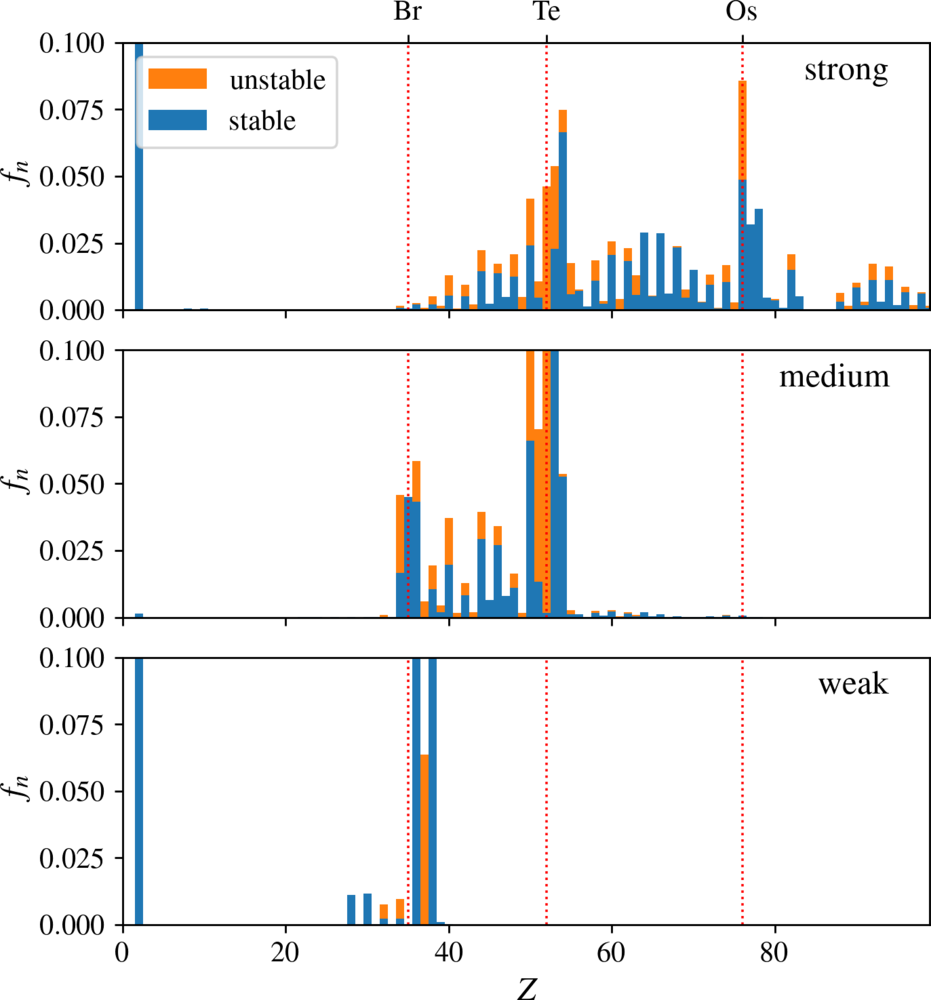
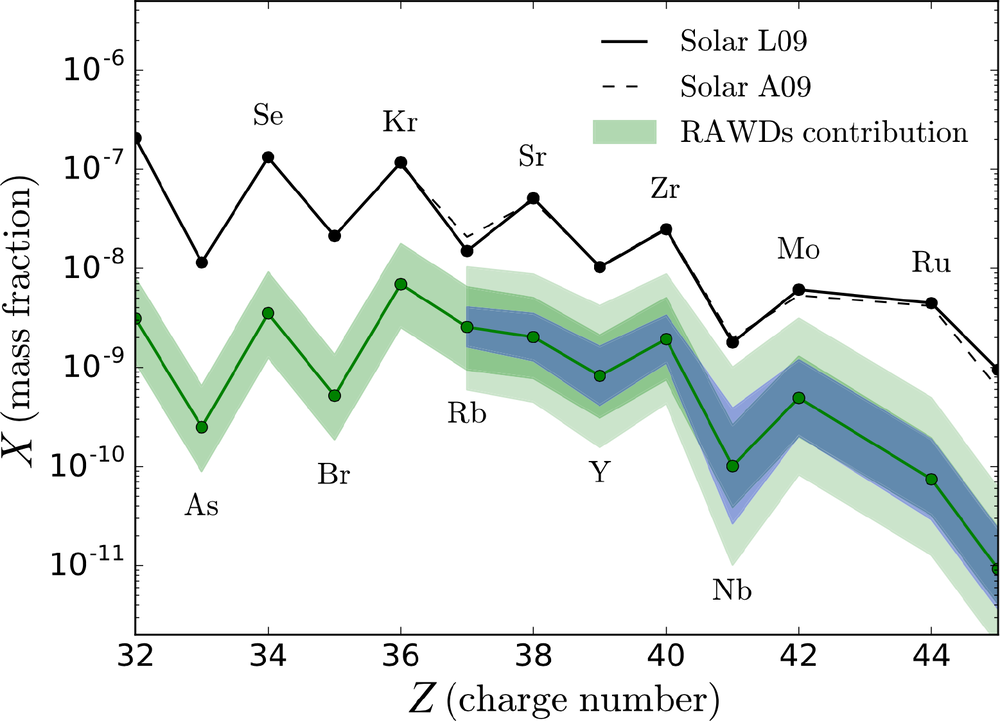
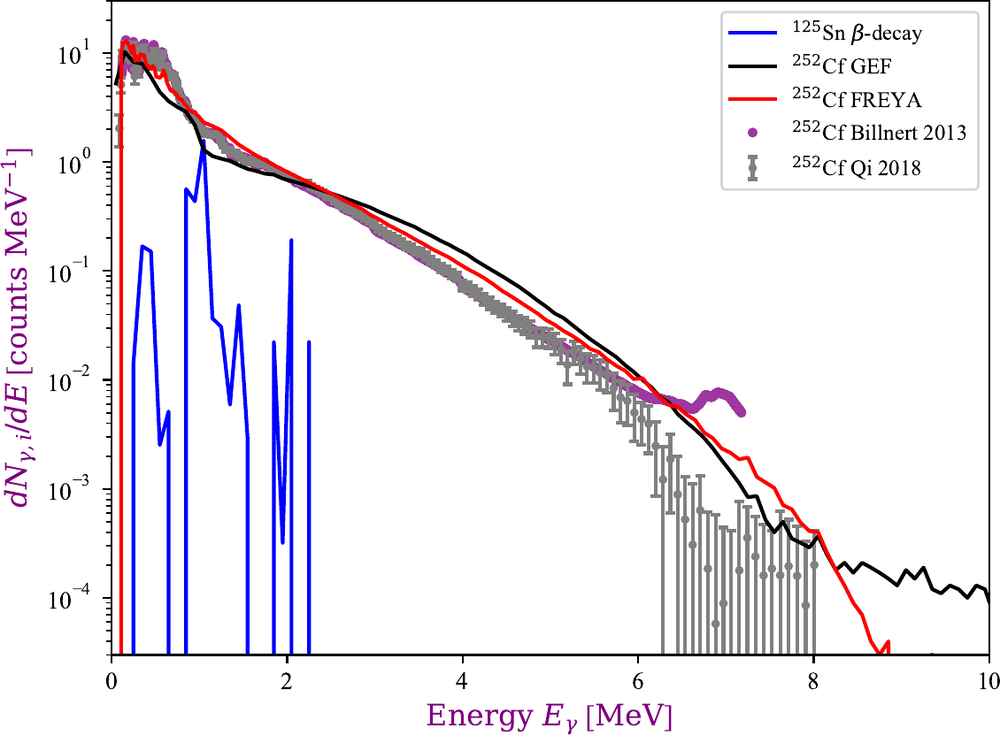
Axel joined Los Alamos as a postdoc in 2024 to work with me on the detectable $\gamma$-ray emission of freshly synthesized heavy elements. Radioactive decay of nuclei made in the rapid neutron capture or $r$-process releases electrons, $\gamma$-rays, neutrinos and neutrons. Axel led a first-principles calculation of the emission spectra from the $\beta$-decay of $r$-process nuclei, coupled to a reaction network simulation to follow them in time. He then compared the $\gamma$-ray spectra of limited, weak, strong and extended $r$-process scenarios across a broad range of timescales, identifying the nuclei that contribute most and discussing practical challenges to observing them.
Machine learning and uncertainties for nucleosynthesis
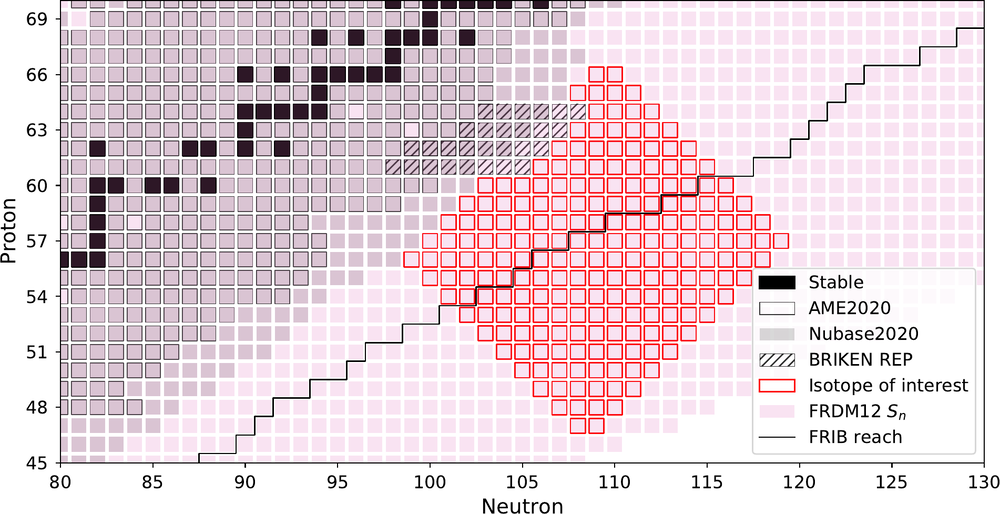
Yukiya was a graduate student at TRIUMF from 2019 to 2023, working with me on machine learning and nucleosynthesis. As first author he introduced ensemble Bayesian model averaging to quantify the uncertainty of nuclear mass model predictions, and later built a feed-forward neural network emulator for the final $r$-process abundance pattern in the rare-earth region, taking $\beta$-decay half-lives and one-neutron separation energies as input. He also contributed to the first measurement of $\beta$-delayed neutron-emission probabilities of 28 neutron-rich Pm, Sm, Eu and Gd isotopes at RIKEN.
Postdoc · Princeton · 2024–present: Electron transport for kilonovae
Figure from Andalman et al. (2026).
Beta-particle heating in kilonova ejecta
Zack is a postdoc at Princeton working with me on electron transport for kilonovae. Kilonovae are powered by the decay of $r$-process nuclei, and their light depends on how the decay products thermalize. Many modeling codes treat $\gamma$-ray heating with full radiation transport, but heating by $\alpha$- and $\beta$-particles relies on simplified descriptions of collisions and transport, which remains an important source of uncertainty. Zack is first author of a paper on $\beta$-particle transport and thermalization in kilonova ejecta that uses detailed atomic microphysics. The paper is currently submitted.
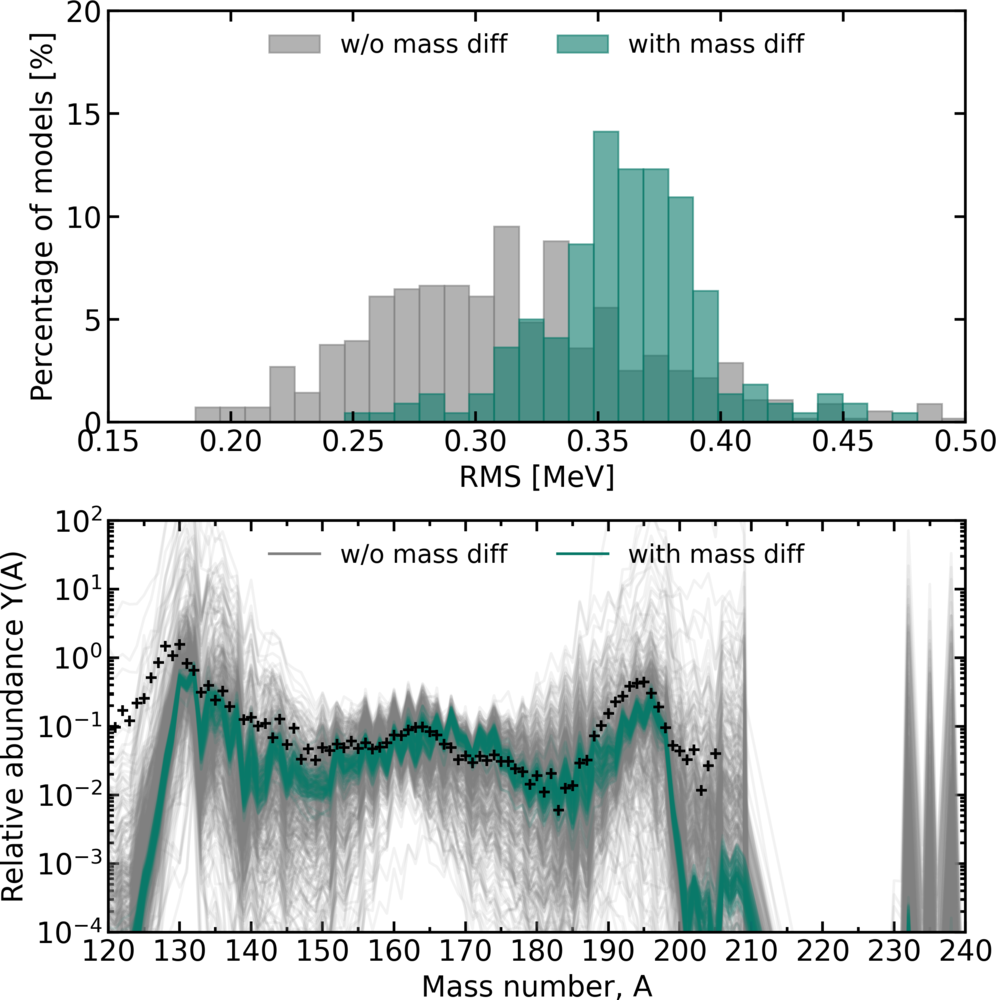
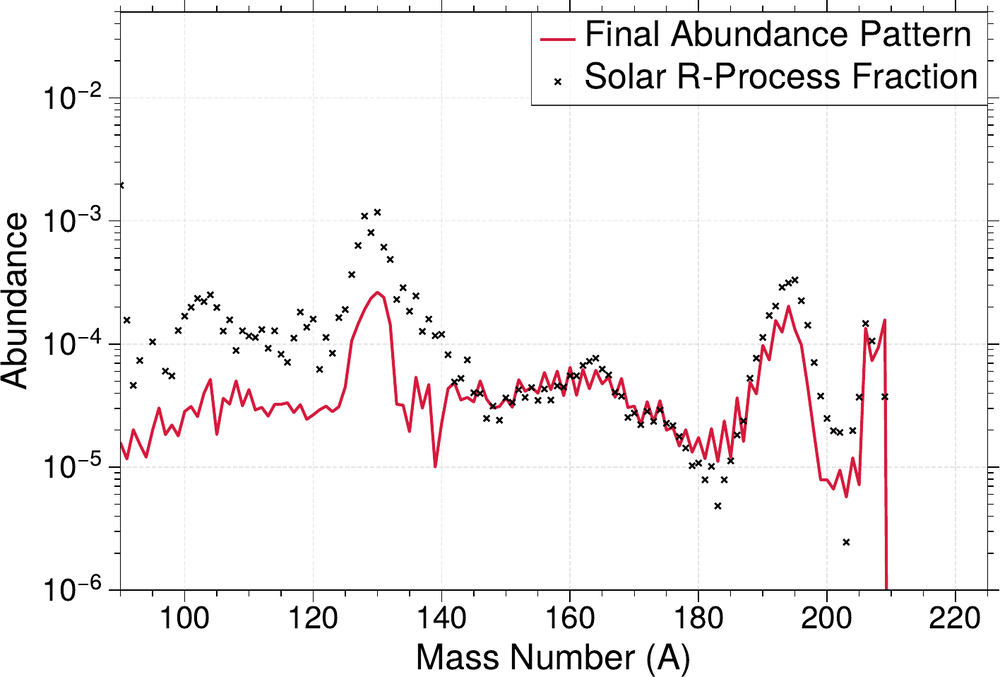
Mengke worked with me first as a graduate student at Clemson (2022 to 2023) on machine learning for atomic nuclei, and is now a postdoc at Notre Dame working on Pareto frontiers. Predicting nuclear masses far from stability is a long-standing challenge. Mengke built a physics-informed machine learning mass model and, for the first time, used it to simulate $r$-process nucleosynthesis, comparing abundances to solar data. More recently Mengke introduced a multi-objective optimization approach based on the Pareto Front algorithm to identify models whose $r$-process abundances match both solar and stellar data, a promising route to models with reliable extrapolation.
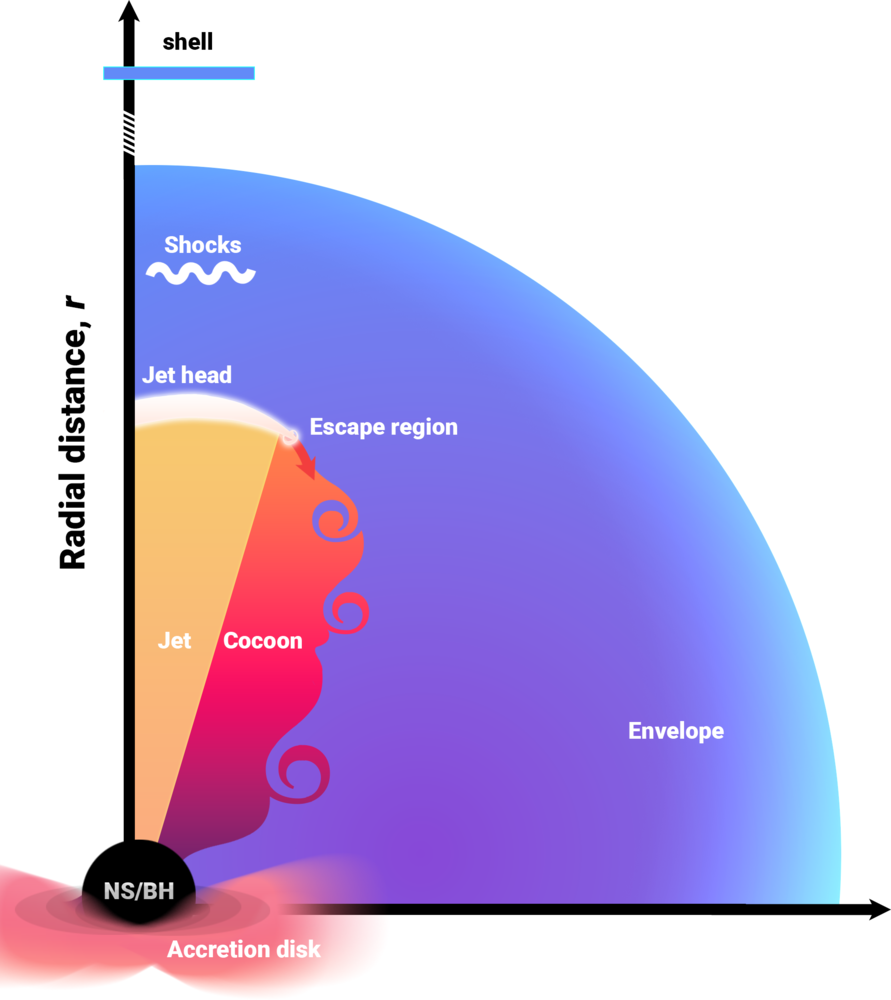
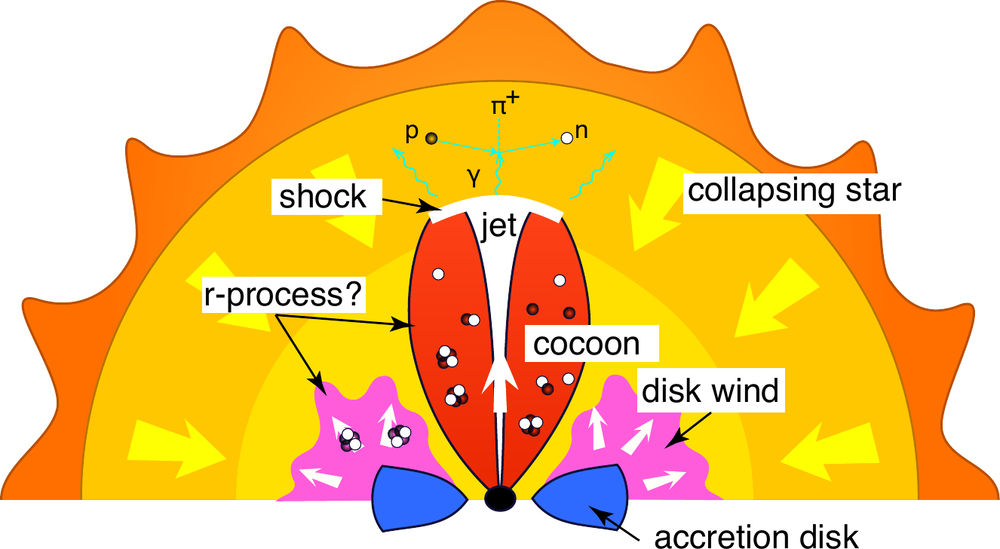
Brandon joined Los Alamos as a postdoc in 2024 and holds a Metropolis Fellowship. With me and colleagues he has worked on how high-energy photon environments, such as gamma-ray bursts and collapsars, can drive neutron-rich nucleosynthesis. One paper proposes that neutrons can be generated in situ by hadronic photoproduction off baryons in the jet and surrounding material, so that even material devoid of neutrons becomes neutron-rich. A second shows that kilonova-like emission following GRB211211A and GRB230307A is consistent with a collapsar scenario with a single weak $r$-process component, without lanthanide-rich material.
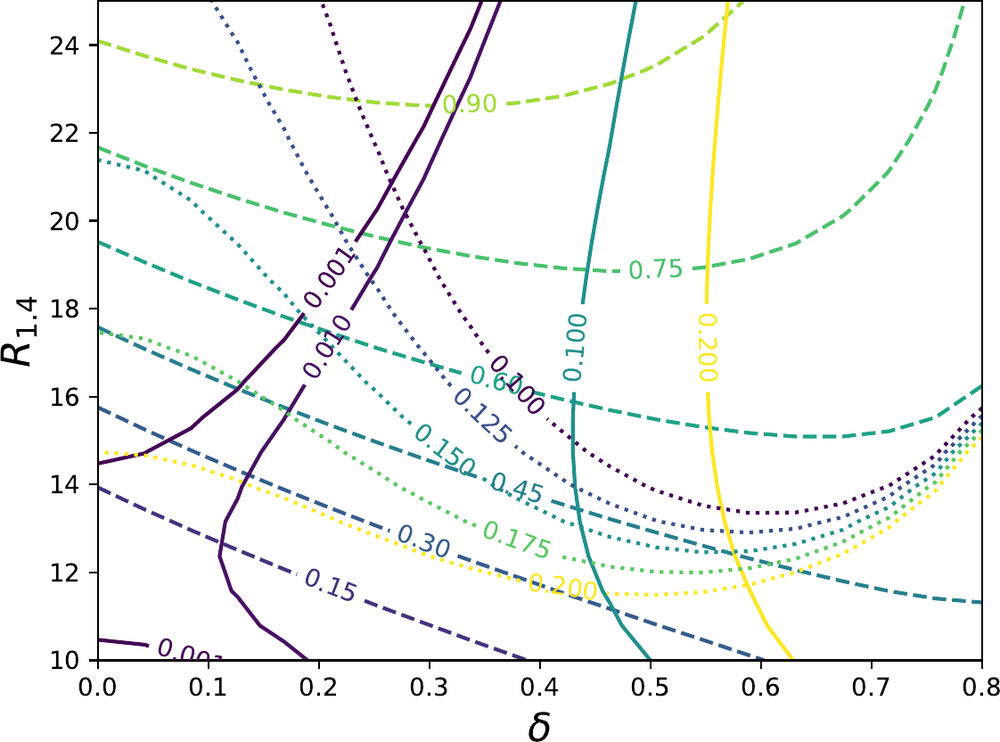
Marko joined Los Alamos as a postdoc in 2024 to work with me on kilonova modeling. Kilonovae are powered by radioactive decay in neutron star merger ejecta. Marko compared the input compositions of realistic kilonova simulations with observed $r$-process abundances, and was first author on a joint electromagnetic and gravitational-wave reassessment of GW170817 and AT2017gfo using a simulation-based surrogate kilonova model. That analysis favors a narrow range of ejecta properties, while conclusions about the neutron star's mass and radius depend strongly on assumptions about the ejected mass. He also contributed to neural-network interpolation of kilonova light curves trained on 22248 radiative transfer simulations.
Marko led a study of the kilonova-like emission seen after the long-duration gamma-ray bursts GRB211211A and GRB230307A, which has been interpreted as coming from neutron star mergers. He showed these observations are also consistent with nucleosynthesis in a collapsar. The model reproduces the observed optical and infrared light curves with a single weak $r$-process component. Because it contains no lanthanide-rich material, consistent with the data, the result challenges the view that a red evolution in such transients necessarily indicates heavy $r$-process elements.
Samuel joined Los Alamos as a postdoc in 2024 to work with me on the development of PRISM, the reaction network framework we use to simulate nucleosynthesis. Reaction networks follow how the composition of an astrophysical environment changes in time, and they underpin our predictions of what freshly made heavy elements emit as they decay. Samuel is a co-author on our first-principles calculation of the electrons, $\gamma$-rays, neutrinos and neutrons emitted by $r$-process $\beta$-decay, on the $\gamma$-ray spectra of different $r$-process scenarios, and on a study showing that the kilonova-like emission after two long-duration gamma-ray bursts is consistent with a collapsar.
Uncertainty quantification for nuclear data fitting
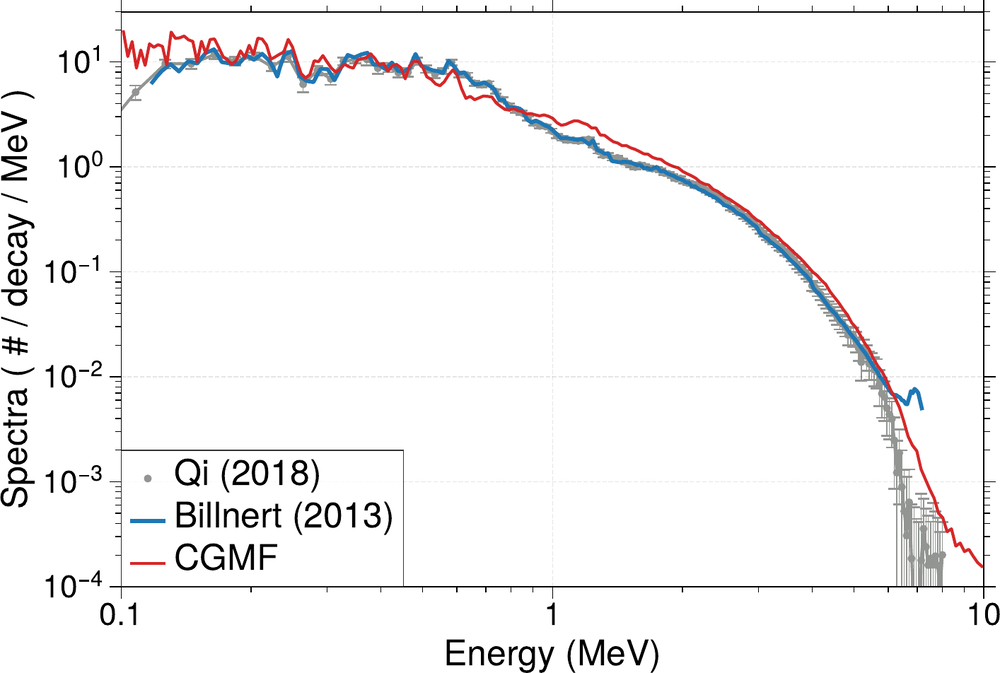
Marko was a postdoc at Los Alamos from 2024 to 2025, working with me on uncertainty quantification. He was first author on three papers on fitting nuclear data. One extends the Levenberg-Marquardt algorithm to multichannel cross section data for the Hauser-Feshbach code CoH3, using a weighted Fisher Information Metric. A second introduces an optical-lensing inspired data thinning method that cuts computational cost without compromising uncertainty quality. The third uses information geometry to study how reduced measurement uncertainties in pre-neutron mass distributions affect parameter estimation in the fission code CGMF.
Postdoc · Hubble · 2022–2023: Superheavy production in the $r$-process
Graduate student · ND · 2016–2020: Fission in the $r$-process and PRISM
Figure from Holmbeck et al. (2018).
Actinide production in $r$-process stars
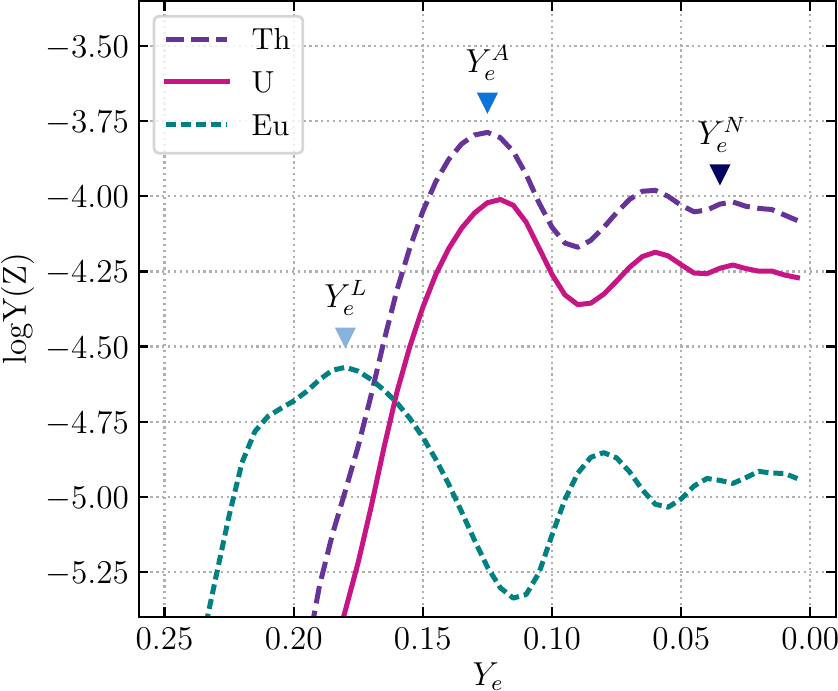
Erika worked with me as a graduate student at Notre Dame (2016-2020) on fission in the $r$-process and PRISM. She investigated actinide production in the dynamical ejecta of a neutron star merger, asking whether varying neutron richness can explain the actinide over-enhancement seen in about 30% of $r$-process-enhanced stars. Her analysis found that actinide-boost stars do not require a separate $r$-process progenitor, and that variations in actinide-to-lanthanide ratios are most likely astrophysical, set by how neutron-rich the ejecta are, rather than due to nuclear uncertainties. She also contributed to work showing that element abundance patterns in stars indicate fission of nuclei heavier than uranium.
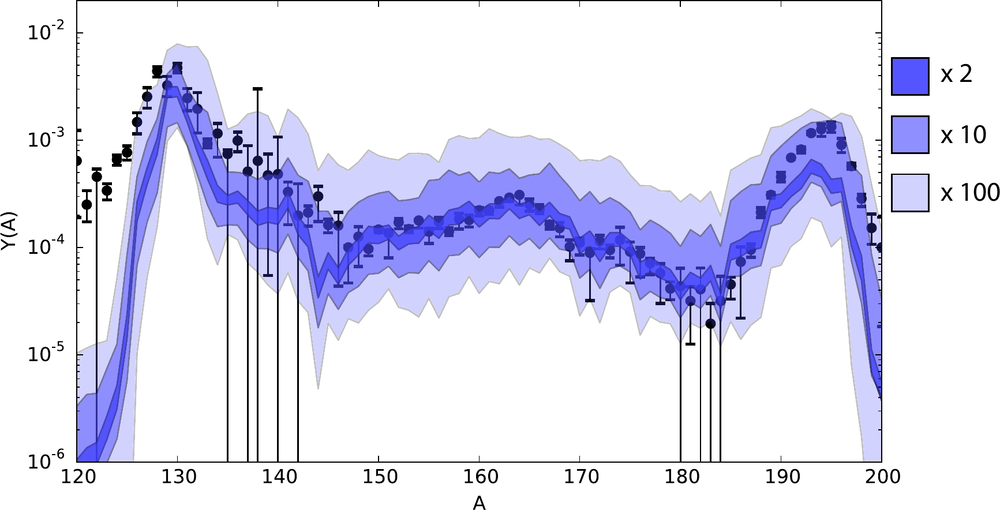
Erika asked whether neutron star mergers can explain the heavy elements in the Galaxy by taking an inverse approach. Instead of propagating merger rates and yields forward, she used $r$-process abundance ratios of metal-poor stars as input to reconstruct the properties, especially the masses, of the neutron star binary progenitors of those stars. Related work, in which Erika is a co-author, constrained inputs to realistic kilonova simulations by comparing them with observed $r$-process abundances.
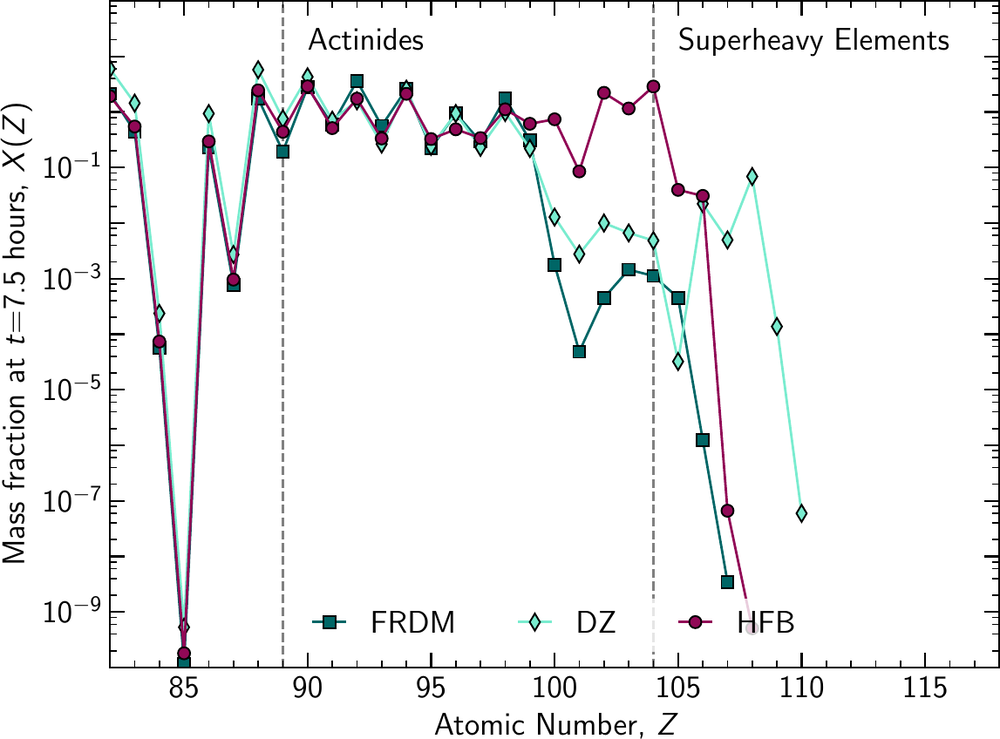
As a Hubble Fellow (2022-2023) Erika turned to superheavy production in the $r$-process. The $r$ process must make superheavy nuclei, with extreme proton numbers, neutron numbers or both, far from laboratory reach. A first-author overview describes how the process synthesizes the actinides and potentially superheavies and what questions remain. A companion study investigated very neutron-rich nuclei that can produce superheavy elements ($Z \ge 104$) in neutron star mergers and whether they imprint a unique signature on kilonova light curves.
Postdoc · LANL · 2020–2023: Low energy fission dynamics
Graduate student · ND · 2016–2020: PRISM: A reaction network framework for nuclear astrophysics
Undergraduate student · ND · 2013–2016: PRISM: A reaction network framework for nuclear astrophysics
Figure from Sprouse et al. (2021).
Nucleosynthesis tracing and decay networks
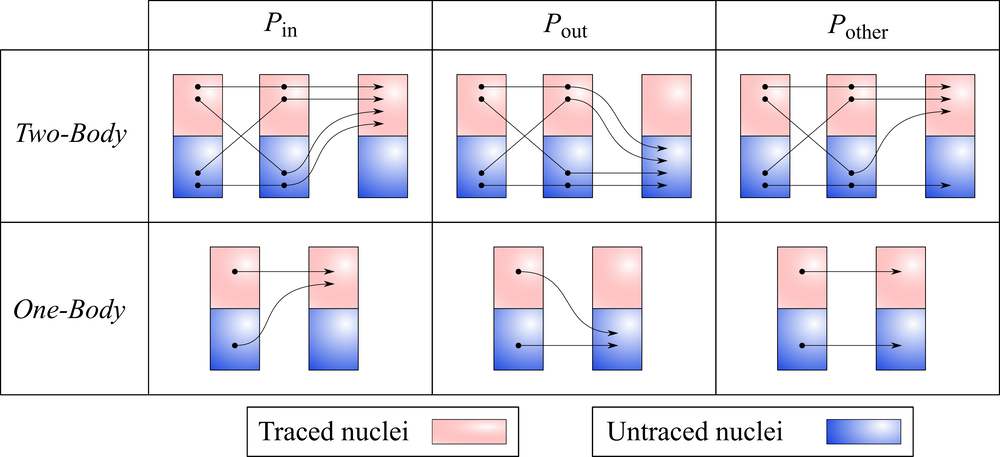
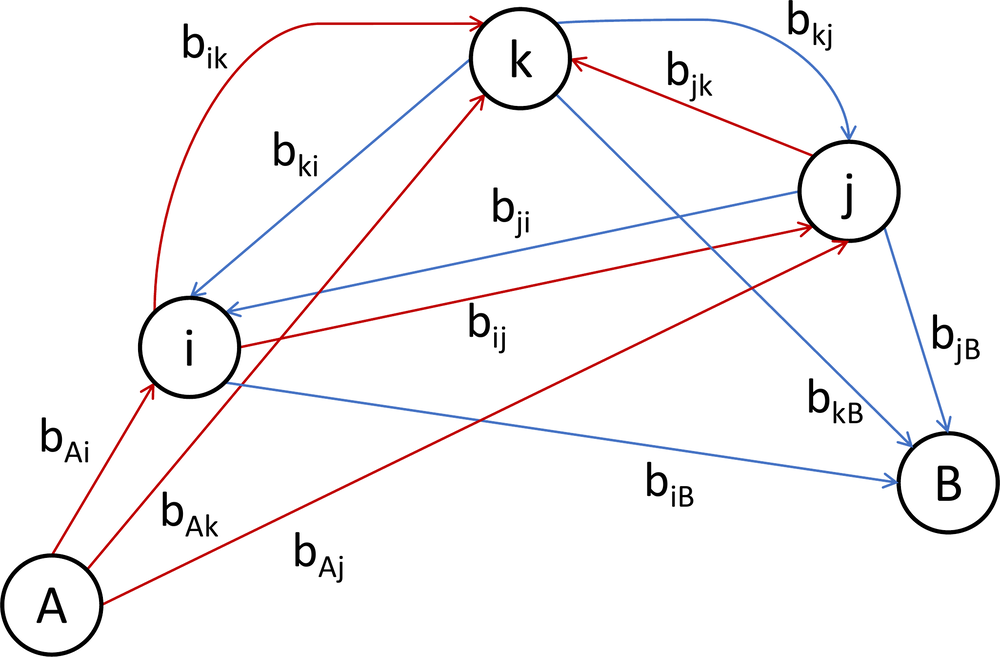
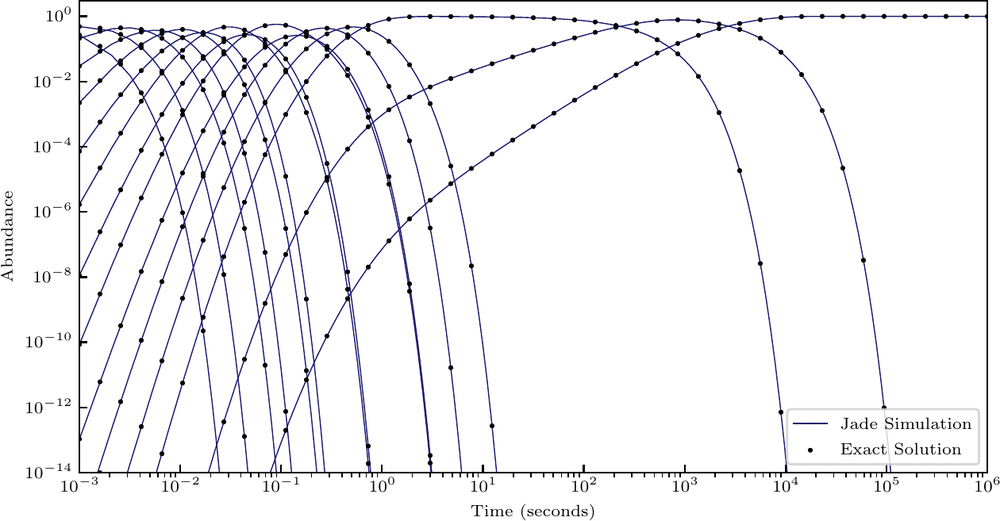
Trevor began working with me as an undergraduate at Notre Dame in 2013 on PRISM, a reaction network framework for nuclear astrophysics, and continued on it as a graduate student. Reaction networks follow the changing composition of stellar material through nuclear reactions and decays. Building on this, Trevor developed a nucleosynthesis tracing technique that quantifies the role of individual reactions, decays and fission processes within the full network, and applied it to fission and $\beta^{-}$-decay in the $r$-process. He also created a decay network that follows the late-time $r$-process, where nuclei with similar half-lives are populated at the same time, and propagated mass-model uncertainties to $r$-process abundances.
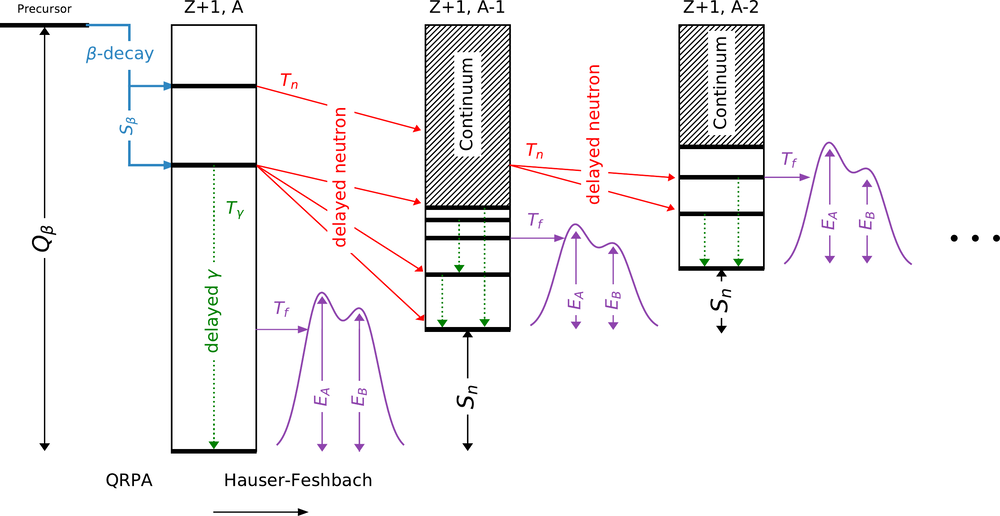
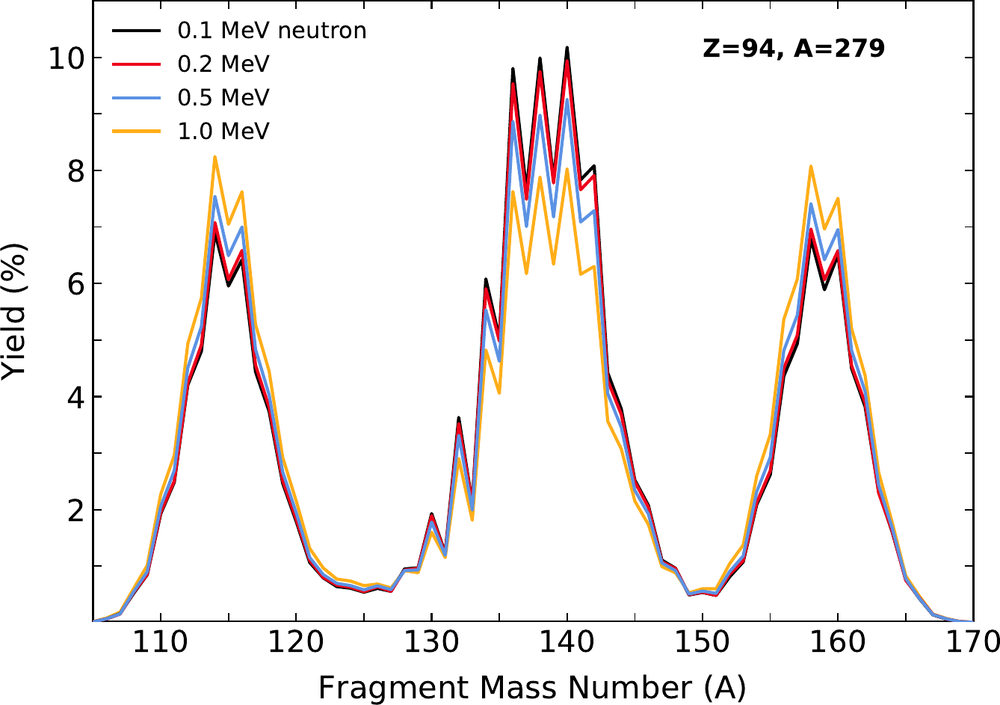
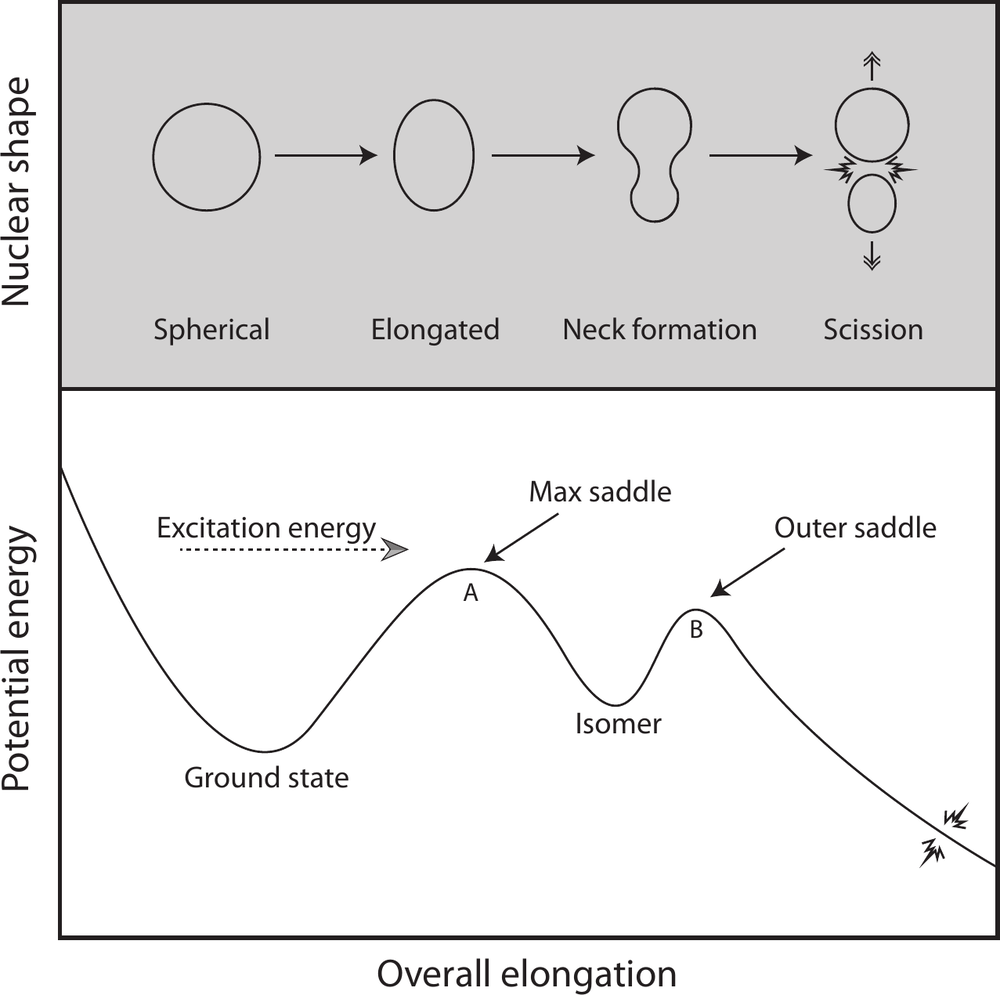
After his PhD Trevor moved to Los Alamos as a postdoctoral researcher (2020-2023), where his topic was low-energy fission dynamics. Using the macroscopic-microscopic approach to fission, he and collaborators ran Metropolis random walks across nuclear potential-energy surfaces built from the Finite-Range Liquid-Drop Model plus single-particle terms, to obtain distributions of nascent fission fragments. The predictions were compared with experimental data for two major actinides, and global trends as a function of the mass number of the fissioning nucleus were examined, along with their implications for nucleosynthesis. Trevor also contributed to work on $\beta^{-}$-delayed fission with a quasi-particle random phase approximation plus Hauser-Feshbach approach.
Postdoc · U. Vic. · 2021–2022: Python interface for URSA
Figure from Cote et al. (2019).
Chemical evolution and the origin of $r$-process elements
Benoit was a postdoctoral researcher at the University of Victoria (2021-2022), where his topic was a Python interface for URSA. His papers with me connected nuclear physics to the chemical evolution of the Galaxy. He showed that nuclear physics and galactic evolution uncertainties both significantly affect interpretation of the origin of neutron-capture elements in the Solar System. He also used the meteoritic $^{129}$I/$^{247}$Cm ratio as a direct constraint on the last $r$-process event before the Sun formed, finding that moderately neutron-rich disk ejecta can produce it.
Postdoc · ND · 2020–2022: Fission $\gamma$-rays in the $r$-process
Figure from Wang et al. (2020).
Spallation and fission gamma rays from mergers
Xilu was a postdoctoral researcher at Notre Dame (2020-2022) working on fission gamma rays in the $r$-process. She included photons from fission for the first time in estimates of the MeV gamma-ray signal from a neutron star merger and found a dramatic difference depending on whether fissioning nuclei are produced. Xilu also modeled spallation: merger ejecta move fast enough to initiate spallation reactions with interstellar medium particles, which may shift $r$-process abundance patterns toward solar data near the low-mass edges of the peaks. She also co-authored the thallium-208 gamma-ray paper.
Postdoc · Columbia · 2019–2022: Nuclear uncertainties for kilonova
Figure from Barnes et al. (2021).
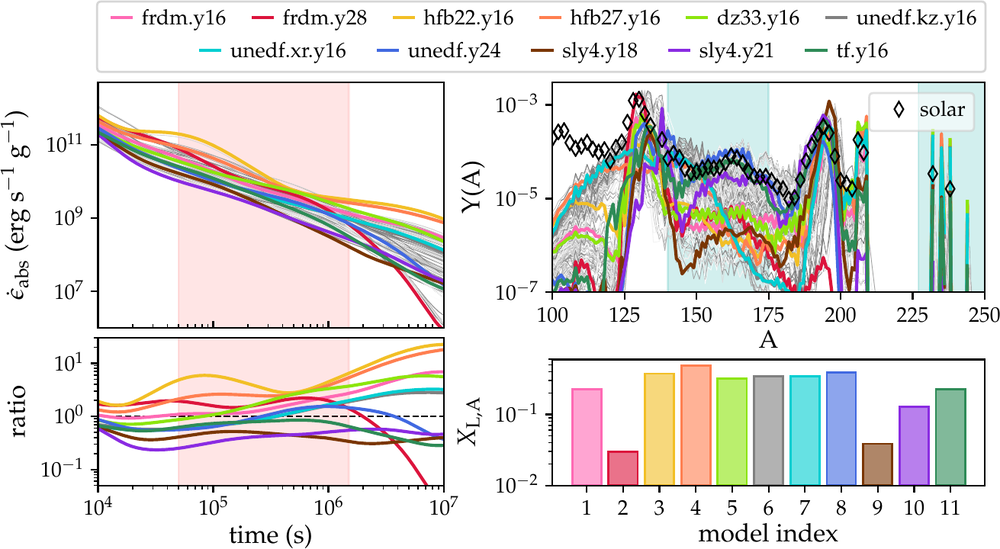
Nuclear uncertainties in kilonova modeling
Jennifer was a postdoctoral researcher at Columbia (2019-2022) working on nuclear uncertainties for kilonova modeling. Kilonova emission, if interpreted accurately, can characterize the masses and compositions of merger outflows, but uncertain nuclear properties complicate that inference. Jennifer and collaborators used $r$-process simulations to show how nuclear physics uncertainties affect predictions of radioactive heating and element synthesis. She was also a co-author on a study of nuclear-input dependence of kilonova light curves and on a search for signatures of superheavy elements in kilonova light-curve evolution.
Postdoc · LANL · 2019–2022: Isomers and neutrinos in nuclear astrophysics
Figure from Misch et al. (2021).
Astromers: isomers in astrophysics
Wendell was a postdoctoral researcher at Los Alamos (2019-2022) working on isomers and neutrinos in nuclear astrophysics. He developed a method to compute thermally mediated transition rates between nuclear ground states and long-lived isomers, and criteria for the thermalization temperature below which an isomer must be treated as a separate species, an astrophysical isomer or astromer. He applied it to the $r$-process, computing beta-decay feeding factors and identifying the influential isomers, and performed a sensitivity study of the effect of unknown direct transitions. He later summarized the status and prospects of astromers.
Wendell extended the astromer work to other nucleosynthesis settings. In a study of the late-time $r$-process, a decay network built from the latest experimental and evaluated data showed that nuclei with similar half-lives are populated at the same time, an isochronic evolution. For the $s$-process, he calculated effective thermal transition rates and thermal beta-decay rates for the long-lived isomer of $^{85}$Kr, a branch point nucleus, and found that including the isomer shifts abundances.
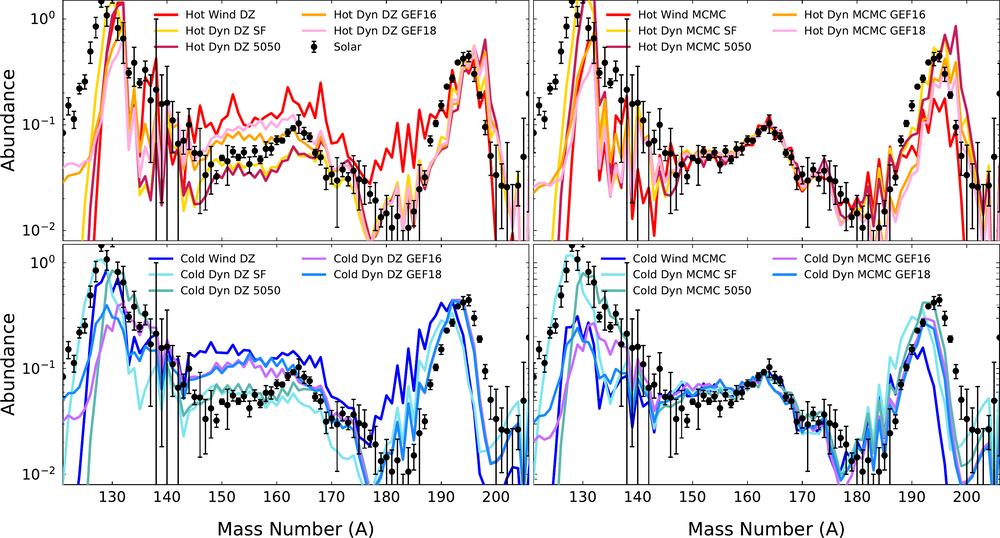
Nicole was a postdoctoral researcher at Notre Dame (2016-2021) who worked with me on reverse engineering nuclear properties from astrophysical observations. Much of her work examined fission in the $r$-process. She used excitation-energy dependent fission yields and showed that asymmetric-to-symmetric yield trends from the GEF code can reproduce the high-mass edge of the second $r$-process peak in solar data. She then applied fission yields from the macroscopic-microscopic Finite Range Liquid Drop Model for the first time, with fission rates and yields from one theoretical framework, and reviewed how fission properties may relate to abundance universality in metal-poor stars.
Nicole developed a Markov Chain Monte Carlo procedure to predict the nuclear masses needed to form the rare-earth abundance peak seen in solar $r$-process data. She applied it to several astrophysical outflows with distinct $r$-process dynamics and found the results most sensitive to those dynamics. Regardless of whether fission deposits material into the rare-earths, the algorithm consistently called for a local feature of enhanced stability in the neutron-rich lanthanides. She also tested how different reported solar abundance residuals change the mass predictions, and compared with precision mass measurements.
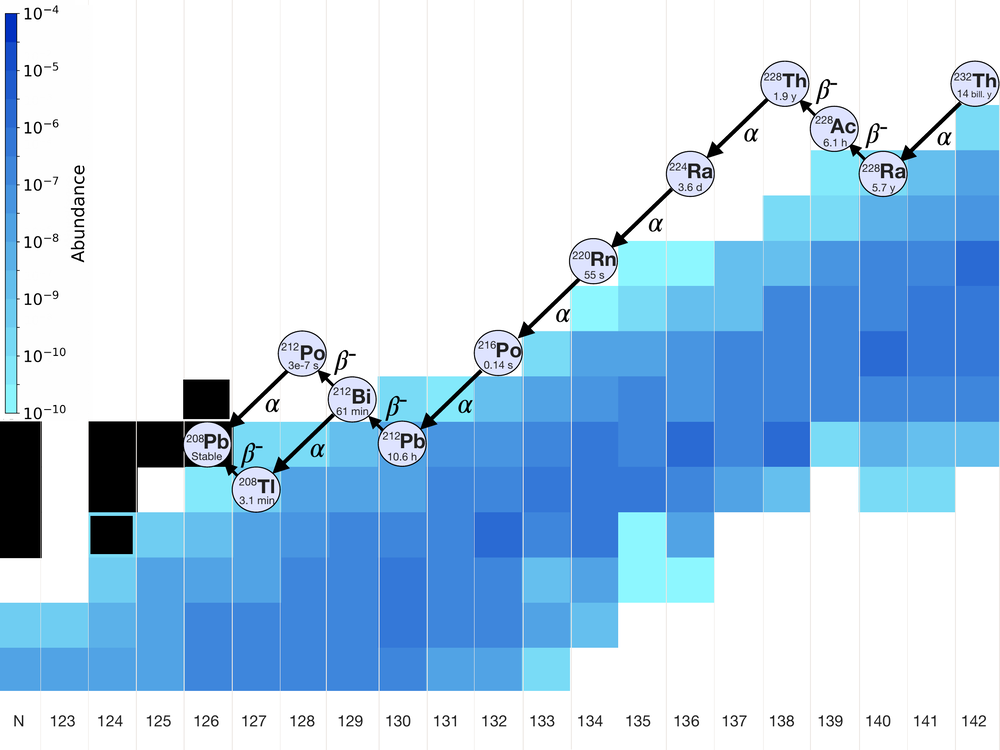
Nicole also studied how $\gamma$-rays could reveal heavy-element production in neutron star mergers. She was a co-author on work led by Xilu Wang that included photons from fission for the first time in estimates of the MeV $\gamma$-ray signal, which differs dramatically depending on whether fissioning nuclei are produced. Nicole then showed that the 2.6 MeV $\gamma$-ray line of $^{208}$Tl could serve as a real-time indicator of $r$-process and intermediate neutron capture nucleosynthesis, detectable in a Galactic merger from about 12 hours to 10 days and again about 1-20 years after the event.
Postdoc · LANL · 2017–2020: Fission yields in the microscopic macroscopic approach
Figure from Verriere and Mumpower (2021).
Fission yields in the macroscopic-microscopic approach
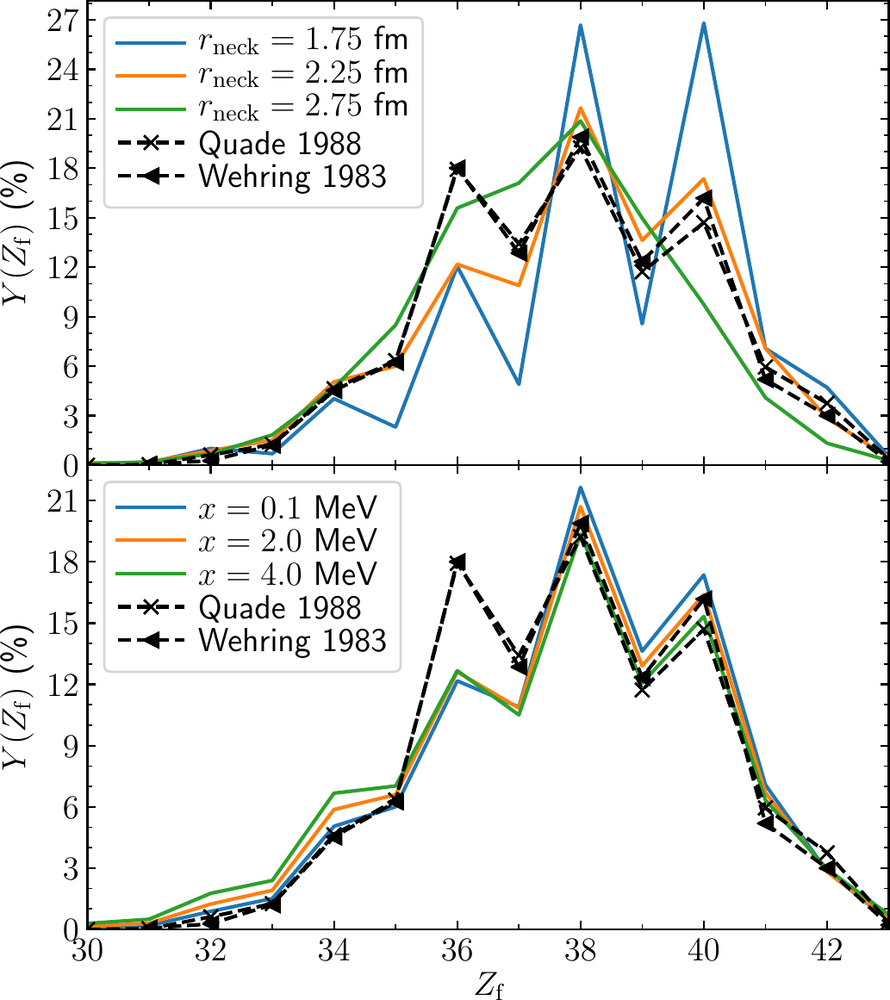
Marc was a postdoc at Los Alamos from 2017 to 2020, working with me on fission yields in the macroscopic-microscopic approach. This approach predicts fission fragment yields for a broad range of fissioning systems. Marc was first author of a paper presenting several enhancements: improved microscopic potential energy surfaces and a deterministic Markov chain method for strongly damped fission dynamics. He also contributed to a calculation of primary fission fragment mass yields across the chart of nuclides, including nuclei relevant to the $r$-process, and to a later conference paper using Metropolis random walks.
Postdoc · LANL · 2017–2019: FRLDM fission yields across the chart of nuclides
Figure from Mumpower et al. (2020).
Fission yields for the $r$-process
Patrick was a postdoc at Los Alamos from 2017 to 2019, working with me on fission yields across the chart of nuclides using the finite-range liquid-drop model. Fission matters for the $r$-process in very neutron-rich merger ejecta. Patrick contributed to a calculation of primary fission fragment mass yields across the chart of nuclides, to a study of excitation-energy dependent fission yields that identifies key fissioning nuclei, and to a review of fission properties relevant for GW170817. He was also a co-author on the work identifying $^{254}$Cf as an isotope with a large impact on kilonova light curves.
Ben was a graduate student at Clemson from 2024 to 2025, working with me on detectable $\gamma$-ray emission from $r$-process nucleosynthesis. As first author he assessed whether the radioactive decay of $r$-process-enriched kilonova and supernova remnants in the Milky Way could be seen directly in $\gamma$-rays. He modeled the spatial distribution of potential remnants and generated synthetic time-evolving spectra, then compared predicted fluxes to the sensitivity limits of an all-sky survey with mock COSI-like instruments and of targeted observations with low field-of-view instruments similar to HEX-P.
Graduate student · NCSU · 2019–2024: Heavy element formation in the $r$-process
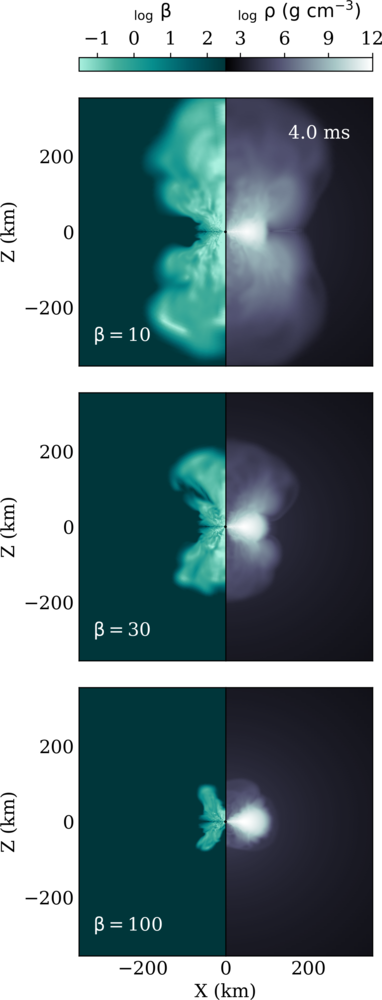
Figure from Lund et al. (2024).
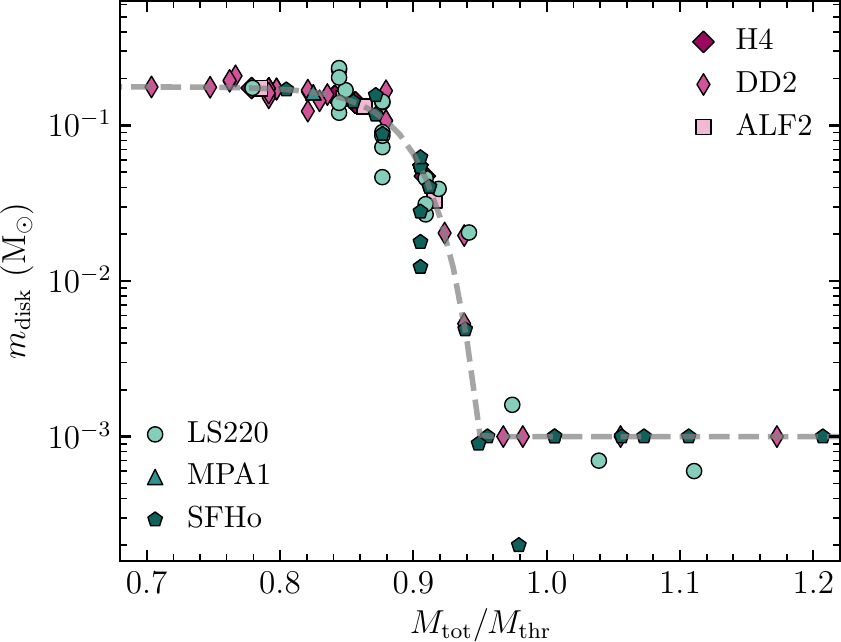
Nucleosynthesis from merger accretion disks
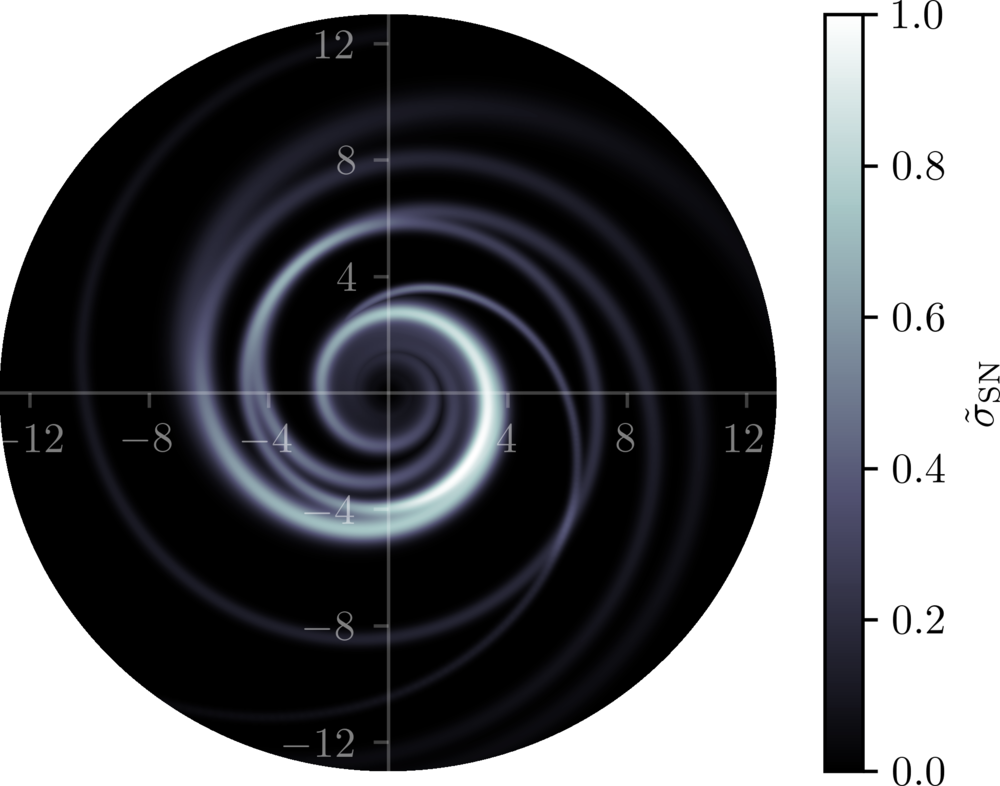
Kelsey was a graduate student at North Carolina State University (2019-2024) working on heavy element formation in the $r$-process. She studied how beta-decay rates influence $r$-process observables and kilonova modeling, and simulated black-hole accretion disks formed after neutron star mergers. She found that ejecta mass increased with the initial magnetic field strength while a robust main $r$-process pattern appeared in all cases, and contributed to a 1.2 second disk simulation spanning the $r$-process timescale. Kelsey also connected kilonova light curves to the nuclear equation of state.
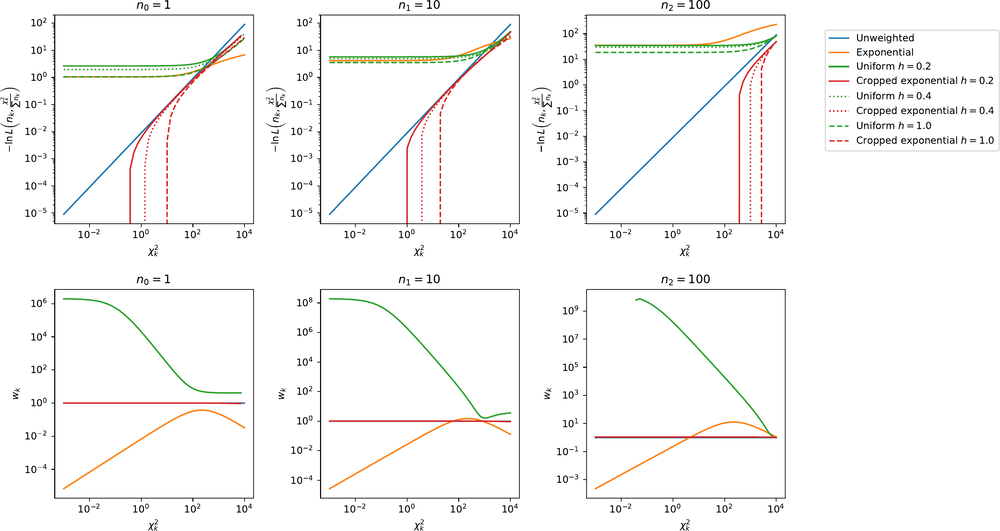
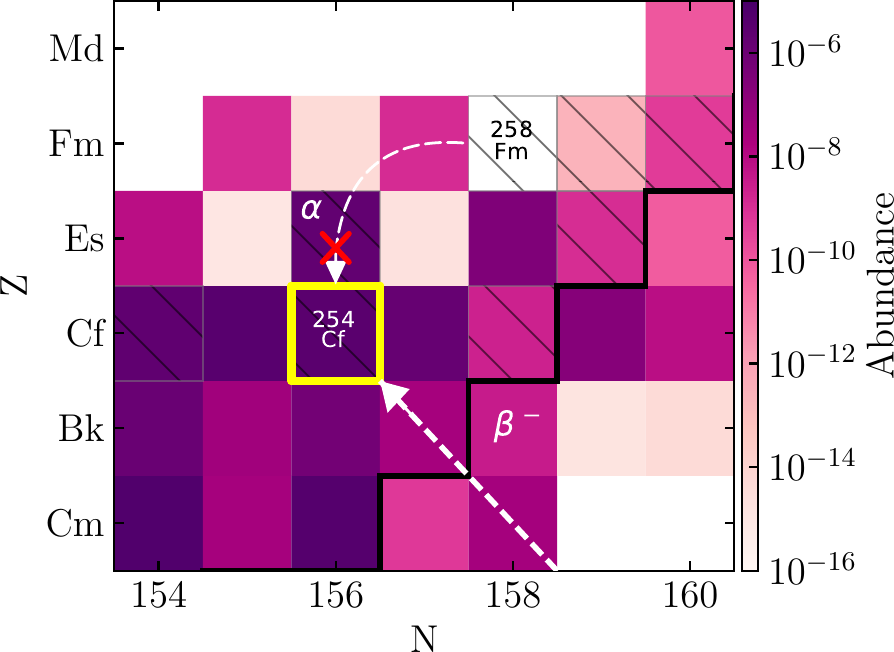
Yonglin was a graduate student at North Carolina State University (2018-2020) studying how nuclear physics affects kilonova light curves. His first paper identified a single isotope, $^{254}$Cf, with a large effect on kilonova brightness at roughly 15 to 250 days, owing to its long half-life and the efficiency of fission thermalization. He then used 12 theoretical mass models to show that the uncertainty in total nuclear heating is a factor of a few. A later study of 32 combinations of nuclear inputs found uncertainties of at least an order of magnitude in key quantities.
Graduate student · GSI · 2019: Reaction rate uncertainties for the $r$-process
Figure from Nikas et al. (2020).
Hauser-Feshbach uncertainties in the $r$-process
Stylianos was a graduate student at GSI who worked with me in 2019 on reaction rate uncertainties for the $r$-process. He led an investigation of the uncertainty in neutron capture rates away from stability calculated with the Hauser-Feshbach model, extrapolating models of statistical properties to neutron-rich nuclei far from stability, and provided a quantitative measure of how dependable the calculations are. The uncertainty estimates were propagated into $r$-process nucleosynthesis calculations, which matters for comparing theoretical yields with astronomical observations.
Graduate student · MSU · 2017 summer: Investigation of nu-bar and its impact on fission in the $r$-process
Statistical Hauser-Feshbach modeling
Alex, then a graduate student at Michigan State University, worked with me in the summer of 2017 on statistical Hauser-Feshbach modeling, the framework used to predict neutron-capture rates for nuclei far from stability. His experimental work with the $\beta$-Oslo method helps constrain such rates, including neutron capture on $^{68}$Ni.
Undergraduate student · UW · 2026–present: $r$-process and uncertainty propagation
Kevin Lee Past
Undergraduate student · ND · 2013–2015: User frontend and chart of nuclides for Notre Dame nuclear database
A dynamic chart of nuclides
Kevin joined the Aprahamian research group late in the fall semester 2013 to work with me on the Notre Dame Nuclear Database project. His focus was the users' interaction with the database through the website. Over the course of 2014 Kevin researched modern web technologies, including HTML, CSS and JavaScript, and used them to create a dynamic chart of nuclides that queries new data without a page refresh and works on computers, tablets and smartphones alike. In the fall of 2014 Kevin presented this project at the Division of Nuclear Physics meeting in Hawaii.
Tim Khouw Past
Undergraduate student · ND · 2013–2015: Search capabilities and API for the Notre Dame nuclear database
An API for the Notre Dame nuclear database
Tim joined the Aprahamian research group late in the fall semester 2013 to work with me on the Notre Dame Nuclear Database project. His focus was the interface between the backend (the database) and the frontends (the web and command-line interfaces). Over the course of 2014 Tim wrote Python code defining the project's application programming interface (API), a standard for well-defined interactions with the database, including search queries and filtering by metadata. In the fall of 2014 Tim presented this project at the Division of Nuclear Physics meeting in Hawaii.
Patrick Fasano Past
Undergraduate student · ND · 2012–2015: Initial development of the Notre Dame nuclear database
Notre Dame nuclear database
Patrick joined the Aprahamian research group in the spring semester of 2013 to work with me on a new database of nuclear physics properties. In the first phase of this project Patrick learned about the properties of nuclei, then designed a complex database structure in MySQL to store this information. Patrick also studied the emission of neutrons during thunderstorms: he was awarded a travel grant from the Nanovic Institute for European Studies at Notre Dame to spend ten weeks in Armenia in summer 2013 at the Yerevan Physics Institute, a leading research center in high energy cosmic rays.
Caleb Marshall Past
Undergraduate student · NCSU · 2011–2012: $\beta$-decays in the rare earth region of the $r$-process
$\beta$-decay sensitivity studies for the $r$-process
Caleb joined the McLaughlin research group in the summer of 2011 to work with me on sensitivity studies of $r$-process nuclei. Over the summer and his senior year he learned to simulate $r$-process nucleosynthesis in various astrophysical environments, focusing on finding the $\beta$-decay rates that matter most for the final abundances we observe in nature. These rates are a primary motivation for measurements of neutron-rich nuclei at radioactive beam facilities. Caleb presented his work at the spring 2012 undergraduate research symposium at NC State.
Also mentored as undergraduates:
Trevor Sprouse(listed under Postdocs)